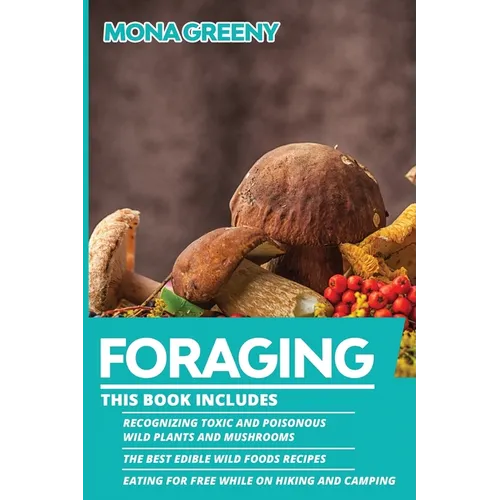
Foraging: This book includes: Recognizing Toxic and Poisonous Wild Plants and Mushrooms + The Best Edible Wild Foods Recipes + Eating for Free while o - Paperback
Foraging: This book includes: Recognizing Toxic and Poisonous Wild Plants and Mushrooms + The Best Edible Wild Foods Recipes + Eating for Free while o - Paperback
by Mona Greeny (Author)
Knowledge puts you on the way to new frontiers. Discover a whole new world of wonderful plants and mushrooms without compromising your safety. In this book, Poisonous Plants and Mushrooms, you learn how to identify toxin-containing mushrooms and poisonous plants.
Learn the Details of Poisons in Plants
Read descriptions of the different plants and mushrooms and what their distinguishing characteristics are and use the photographs for reference. Understand exactly what you can and cannot eat!
Read how to forage the forests for mushrooms safely by learning the identity of poisonous mushrooms and plants. The photos will help you identify and classify them with ease. You can enrich your life by learning how to forage in the nearby woods for new mushrooms and plants.
Are you bored with the same old recipes and dishes all the time? Are you tired of eating foods full of chemicals? Do you want to go back to nature and eat fresh, healthy, and delicious food? Are you scared of filling up your body with chemicals? Do you want to take up a new hobby that will help you save a lot of money while eating healthy food? If the answer to any of the above questions is yes, then you have chosen the right book.
Foraging is one of the best hobbies as it not only provides you pleasure, but it will also help you create delicious and healthy recipes. This book contains a variety of recipes and dishes that can help you prepare tasty food items. The book contains multiple tips, techniques, and methods that will help you identify, harvest, and use a variety of herbs. This book contains ample tips that will help you become a good forager and a great cook.
Foraging involves searching for foods such as edible plants and medicinal herbs in the wild. Humans have always been foragers, at least that was how our forefathers lived. They got edible nourishment from the earth, and this made them very healthy and strong.
There are two major classes of edible foods: edible plants, trees, fungi, and weeds. Edible weeds include the weeds that grow in fields, trees, farms, and backyards and are mostly ignored because many have no idea that they can be consumed. Some of them include alfalfa, blue vervain, borage, bugleweed, bull thistle, cattail, chickweed, and so on. Edible flowers, on the other hand, include flowers known mostly as decorative items but can be consumed and are highly nutritious.
Foraging is an act of searching the wilderness for plants, herbs, and fungi that is useful to us. While the initial definition of the word was intended to define the search for food items, it now includes searching for plants suitable for health and wellness.
Foraging is generally associated with camping and trekking through the forests of the world. In reality, even using a wild plant growing at the end of your street can be considered foraging.
Our ancestors have used wild plants and mushrooms since the early stages of human life for their survival. Many of these contain minerals, vitamins, and other compounds that can be used for curing certain diseases or for general health. Most of these plants have been labeled as weeds because of their ability to grow almost anywhere, but are editable and have healing properties.
The most important part of foraging is the ability to identify a plant correctly and to figure out if it is edible or useful and not poisonous. To do this, a person needs a lot of guidance and experience. Over the years, foragers have documented the plants that they have come across, along with their uses to humans. In this guide, we'll take a look at everything you need to know, including pictures and tips on how to identify safe plants and their dangerous look-alikes.
Couldn't load pickup availability

Alert me if this item is restocked.
We often restock popular items or they may be returned by the other customers. If you would like to be notified when this happens just enter your details below.
Foraging: This book includes: Recognizing Toxic and Poisonous Wild Plants and Mushrooms + The Best Edible Wild Foods Recipes + Eating for Free while o - Paperback
We respect your privacy and don't share your email with anybody.
Alert me if this item is restocked
(Real) Ingredients
(Real) Ingredients
We use real pronounceable ingredients that are ethically sourced and high quality for your product.
We either grow or work with local growers to source for our formulas. This supports the local economy, gives us the most potent plants & reduces reliance upon fossil fuels.
We make products from herbs that will grow here over herbs from the Amazon, China, or Africa. Oftentimes, those trendy herbs are taken in an unsustainable way & local people do not have access to their native medicines any longer. Bioregional herbalism is where it's at!
Packaging
Packaging
We are working to eliminate plastic from our packaging. Currently, 99% of our packaging is metal, glass, or paperboard. We are always looking for ways to eliminate microplastics from your body and the planet!
How to Use
How to Use
Herbal remedies, supplements, and tonics are fundamentally different from pharmaceuticals (and we like it that way). They are designed to restore your body and its systems to homeostasis gently- working with your body.
Specifics on dosages and administration for all products are in our FAQ. Find the FAQ in the menu under the "About" Section.
We post basic dosage guidelines, but keep in mind if you have more body mass or a faster metabolism than the average bear, you may need to take a larger dose than indicated. If there are hard-and-fast limitations on how often you can take the product, it will be listed on the package. Most can be used up to six times daily without problems (but we doubt that you would need to do that).
Remember, there are no "magic bullets" in life, and any product (herbal, pharmaceutical, or otherwise) claiming 100% success without knowing you, your constitution, and your lifestyle is lying and trying to get into your wallet. Often, herbalists (and MDs) need to try several products before we find the one that works for your unique biochemistry.
Feel free to email us if the product didn't quite do the job, we can recommend another that could do the trick. We are blessed with many plants that have the same action in the body- and often it's just a matter of finding the right one for you.
The Necessary legal-ese
The Necessary legal-ese
Haven Herbs is not your licensed medical provider and therefore cannot legally offer advice or products to diagnose, treat, or cure any illness.
The content on this site is not intended to substitute for advice given by a physician, a pharmacist, or another licensed healthcare professional. You should not use this information as self-diagnosis or for treating a health problem or disease.
Information and statements on this website regarding dietary supplements have not been evaluated by Health Canada or the FDA of the United States, and are not intended to diagnose, treat, cure, or prevent any disease or health condition. See a practitioner if any condition persists or worsens!